Wednesday, August 10, 2011


Thursday, July 28, 2011
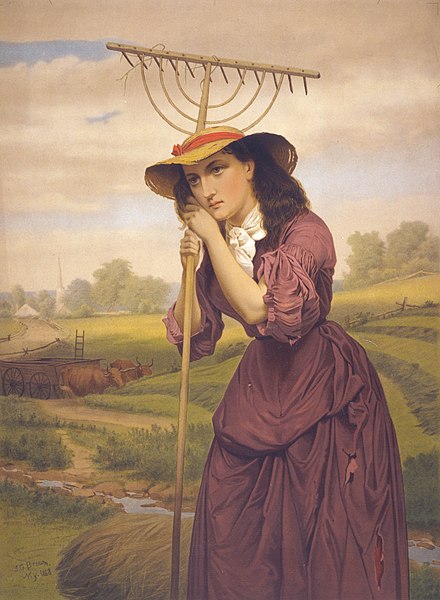
Maud Muller: A Portrait of my Great-great-grandmother
 I have this print hanging in my living room. It is the work of my great-great-grandfather, J. Howard Collier (see his Little Bo Peep and a print of the BVM "after J. Howard Collier." More of his original work is privately owned, much by my family). The model is his wife, Nancy. The title of the portrait is "Maud Muller." It was chosen by Whittier as the first prize winner in an illustration contest in 1863. Interestingly, there was some sort of Act of Congress involved according to the text on the print--perhaps copyright matters? One would think Congress too busy that year for matters as trivial as art. Or, perhaps, Congress understood its true limited function. In any case, despite Google searches, this is the only image of this Maud Muller I could find, and it predates the others. And I rather like it.
 I just realized that it reminds me of Annika in As You Like It:

This image is more common:
Here is the poem:
Maud Muller, on a summer's day,
Raked the meadow sweet with hay.
Beneath her torn hat glowed the wealth
Of simple beauty and rustic health.
Singing, she wrought, and her merry glee
The mock-bird echoed from his tree.
But when she glanced to the far-off town,
White from its hill-slope looking down,
The sweet song died, and a vague unrest
And a nameless longing filled her breast,—
A wish that she hardly dared to own,
For something better than she had known.
The Judge rode slowly down the lane,
Smoothing his horse's chestnut mane.
He drew his bridle in the shade
Of the apple-trees to greet the maid,
And ask a draught from the spring that flowed
Through the meadow across the road.
She stooped where the cool spring bubbled up,
And filled for him her small tin cup,
And blushed as she gave it, looking down
On her feet so bare, and her tattered gown.
"Thanks!" said the Judge; "a sweeter draught
From a fairer hand was never quaffed."
He spoke of the grass and flowers and trees,
Of the singing birds and the humming bees;
Then talked of the haying, and wondered whether
The cloud in the west would bring foul weather.
And Maud forgot her brier-torn gown
And her graceful ankles bare and brown;
And listened, while a pleased surprise
Looked from her long-lashed hazel eyes.
At last, like one who for delay
Seeks a vain excuse, he rode away.
Maud Muller looked and sighed: "Ah me!
That I the Judge's bride might be!
"He would dress me up in silks so fine,
And praise and toast me at his wine.
"My father should wear a broadcloth coat;
My brother should sail a painted boat.
"I'd dress my mother so grand and gay,
And the baby should have a new toy each day.
"And I'd feed the hungry and clothe the poor,
And all should bless me who left our door."
The Judge looked back as he climbed the hill,
And saw Maud Muller standing still.
"A form more fair, a face more sweet,
Ne'er hath it been my lot to meet.
"And her modest answer and graceful air
Show her wise and good as she is fair.
"Would she were mine, and I to-day,
Like her, a harvester of hay:
"No doubtful balance of rights and wrongs,
Nor weary lawyers with endless tongues,
"But low of cattle and song of birds,
And health and quiet and loving words."
But he thought of his sisters proud and cold,
And his mother vain of her rank and gold.
So, closing his heart, the Judge rode on,
And Maud was left in the field alone.
But the lawyers smiled that afternoon,
When he hummed in court an old love-tune;
And the young girl mused beside the well,
Till the rain on the unraked clover fell.
He wedded a wife of richest dower,
Who lived for fashion, as he for power.
Yet oft, in his marble hearth's bright glow,
He watched a picture come and go;
And sweet Maud Muller's hazel eyes
Looked out in their innocent surprise.
Oft, when the wine in his glass was red,
He longed for the wayside well instead;
And closed his eyes on his garnished rooms
To dream of meadows and clover-blooms.
And the proud man sighed, with a secret pain,
"Ah, that I were free again!
"Free as when I rode that day,
Where the barefoot maiden raked her hay."
She wedded a man unlearned and poor,
And many children played round her door.
But care and sorrow, and childbirth pain,
Left their traces on heart and brain.
And oft, when the summer sun shone hot
On the new-mown hay in the meadow lot,
And she heard the little spring brook fall
Over the roadside, through the wall,
In the shade of the apple-tree again
She saw a rider draw his rein.
And, gazing down with timid grace,
She felt his pleased eyes read her face.
Sometimes her narrow kitchen walls
Stretched away into stately halls;
The weary wheel to a spinet turned,
The tallow candle an astral burned,
And for him who sat by the chimney lug,
Dozing and grumbling o'er pipe and mug,
A manly form at her side she saw,
And joy was duty and love was law.
Then she took up her burden of life again,
Saying only, "It might have been."
Alas for maiden, alas for Judge,
For rich repiner and household drudge!
God pity them both! and pity us all,
Who vainly the dreams of youth recall.
For of all sad words of tongue or pen,
The saddest are these: "It might have been!"
Ah, well! for us all some sweet hope lies
Deeply buried from human eyes;
And, in the hereafter, angels may
Roll the stone from its grave away!
Saturday, July 23, 2011
Someplace Warm
So, yesterday, the hottest day in 10 years, I took Annika to visit Wheaton College in Norton Massachusetts. Wheaton is one of those small liberal arts colleges that are so common throughout New England, and is also a former women's college. (Frankly, I think women's colleges are a good thing, in general, but there are few left, and most colleges do offer some housing options for women only.) Despite its origins as a women's seminary (like Mount Holyoke), Wheaton is quite secular. But we were charmed, nonetheless. Everyone smiles, and the presentations from current students, career services (they gave Annika a fun t-shirt), and a professor of art history (one of Annika's interests) were all excellent and informative. I believe she will be applying.
Well, probably. She really wants to go "someplace warm." But, honestly, Dear, this was the hottest school I have visited since the University of Kansas in the summer of 1980. "Haha" was pretty much the response I got from her.
But still, she did like it. On the way up and back, we listened to a lecture series by their resident medieval and Tolkien scholar Prof. Drout, which was really wonderful. And the art history lab demo during the tour was fun and informative, guided by the affable and lively Prof. Staudinger who demonstrated infectious enthusiasm for her work on French medieval cathedrals. Plus, they offer ancient Greek to satisfy their language requirement.
The campus is beautiful, if rather typical of the NE LA colleges--a mixture of Georgian and modern architecture, a small pond (featuring a great blue heron), a central college green, a multi-purpose chapel--and is surrounded by a quaint New England village, including the cliched former Congregationalist churches which are now Unitarian and probably mostly empty. The Catholic church in town is a nearly 2 mile walk along the same street as the college, and is, of course, the ugliest building in town, but Mass is offered in the chapel on Sundays. I did not see any evidence of a Newman club, or any Catholic outreach. But with relatives less than an hour away, I guess it'd be fine.
Afterwards we went up to Auntie Rose's house and had a swim in the pool. The pool was 85 degrees, and hardly refreshing, but it was better than nothing. And the company was wonderful (my mom was visiting my aunt!). Back home by 11pm...and it was still hot.
Well, probably. She really wants to go "someplace warm." But, honestly, Dear, this was the hottest school I have visited since the University of Kansas in the summer of 1980. "Haha" was pretty much the response I got from her.
 |
| "Twisted Sisters"--large art on campus |
But still, she did like it. On the way up and back, we listened to a lecture series by their resident medieval and Tolkien scholar Prof. Drout, which was really wonderful. And the art history lab demo during the tour was fun and informative, guided by the affable and lively Prof. Staudinger who demonstrated infectious enthusiasm for her work on French medieval cathedrals. Plus, they offer ancient Greek to satisfy their language requirement.
The campus is beautiful, if rather typical of the NE LA colleges--a mixture of Georgian and modern architecture, a small pond (featuring a great blue heron), a central college green, a multi-purpose chapel--and is surrounded by a quaint New England village, including the cliched former Congregationalist churches which are now Unitarian and probably mostly empty. The Catholic church in town is a nearly 2 mile walk along the same street as the college, and is, of course, the ugliest building in town, but Mass is offered in the chapel on Sundays. I did not see any evidence of a Newman club, or any Catholic outreach. But with relatives less than an hour away, I guess it'd be fine.
Afterwards we went up to Auntie Rose's house and had a swim in the pool. The pool was 85 degrees, and hardly refreshing, but it was better than nothing. And the company was wonderful (my mom was visiting my aunt!). Back home by 11pm...and it was still hot.
Thursday, July 21, 2011
The Forgotten Pages: Geography
From MacBeth's Opinion website:
Geography, like literature, is a living subject. Avoid the temptation to use a text! It has a history and a future, and is beautiful and fascinating, when presented in an engaging manner. Here are some ideas and books to help you draw your children into the world of geography.

 NGS Student Atlas of the World Get the School and Library binding, not the paperback!
Use Literature to learn geography, and make it a living subject!

Geography, like literature, is a living subject. Avoid the temptation to use a text! It has a history and a future, and is beautiful and fascinating, when presented in an engaging manner. Here are some ideas and books to help you draw your children into the world of geography.
Start simply, with directions
Left, right, backwards, forwards--Don't forget up and down!
Show the children the 4 cardinal directions, north, south, east and west
Learn to use a directional compass
Set up a treasure hunt using a compass, or simple directions for younger kids
When in the car, going somewhere familiar, have the children tell you where to turn
Have older kids write directions (to a store, or friends' houses) for younger kids
Let the kids help plan your next trip, with maps and guide books
Keep a geography center, including:
Maps, both physical and political
a globe
books
National Geographic Magazine (includes at least 5 maps per yearly subscription)
compass (both kinds)
pencils and paper
ruler, protractor
markers
dough recipes for geological features (see Glues, Brews and Goos)
discovery timeline
Reference Books for Geography
Kids' Road Atlas From Rand McNally, this is a real road map, with games and ideas for young travelers
National Geographic Atlas of the World Simply the best; large format, and well worth the money
NGS Student Atlas of the World Get the School and Library binding, not the paperback!
The American Road Trip Planner big and beautiful, from NGS
How the Heather Looks (using British Children's books for geography)
Storybook Travels (using children's books for geographic travels)
Use Non Fiction and Journals:
Dove (a boy's journey around the world alone; wonderful for older high school students)
Use Literature to learn geography, and make it a living subject!
World Geography:
Homesick (an American girl lives in China)
20,000 Leagues Under the Sea (click here for the wonderful audio version)
Islands:
Secret Water (from the Swallows and Amazons series; great living book with map-making)
Island of the Blue Dolphins (Alone on an island; descriptive passages with geographic features)
The Cay (history and geography during WWII in the Caribbean)
Rivers:
Paddle to the Sea, also available on audio!
Going West:
For the youngest (rhyming books about the west by Verla Kay)--Gold Fever and Covered Wagons, Bumpy Trails
West from Home: The Letters of Laura Ingalls Wilder
Explorers (please e-mail me with your favorites!):
Brendan the Navigator:
Columbus:
Leif Eriksson
Magellan
Silly stuff for learning fun:

Thanks to Jen for reminding me. :)
Saturday, July 16, 2011
YA: Romancing the Misery
Last May, at the Book Expo here in NY, I was struck by Sarah Dessen's frank admission (and her free whoopie pies!) about becoming the author of Young Adult books by accident. It seems that when she wrote her first book, she the audience she intended to address was adult, meaning, "grown up," not teens. I have never read a book by Ms. Dessen (though she was a delightful and engaging speaker), but I was amused by her admission. And it got me wondering, just what is a YA book? After looking around the expo, booklists, and library, I came to the shocking conclusion: YA books, for the most part, were books I didn't want my YAs reading. Self indulgent books about drugs, sex, suicide, and every dark thing you can imagine...
Yet, books that deal with all of these matters are not new; "adult" books on these themes have existed since...well, earliest writings, including the Bible. But there is a curious crudeness about the genre. These books seem to, with rare exception, hit one over the head bluntly with bitter misery. Do they enlighten? Do they enrich the YA's life? Or do they just bog teens down in a morass of murky, muddy self pity?
...
When I began this post several weeks ago, I anticipated reading a few of the worst titles in the genre. Since then, this article and this follow-up in the Wall Street Journal and Erin Manning's terrific take (start here) on YA have made my thoughts rather a perfunctory addition to the chatter.
Read all the above, but read this article, as well, on a book about teen suicide that "saves lives" (how does one quantify that assertion?). A follow-up interview with the author of that book is here. I had to laugh as he accused Gurdon (the WSJ book reviewer): "...the tone in her article was very confrontational..." Perhaps he should write a YA book about how to deal with people who disagree with you.
Debate is welcome here, as always.
Yet, books that deal with all of these matters are not new; "adult" books on these themes have existed since...well, earliest writings, including the Bible. But there is a curious crudeness about the genre. These books seem to, with rare exception, hit one over the head bluntly with bitter misery. Do they enlighten? Do they enrich the YA's life? Or do they just bog teens down in a morass of murky, muddy self pity?
...
When I began this post several weeks ago, I anticipated reading a few of the worst titles in the genre. Since then, this article and this follow-up in the Wall Street Journal and Erin Manning's terrific take (start here) on YA have made my thoughts rather a perfunctory addition to the chatter.
Read all the above, but read this article, as well, on a book about teen suicide that "saves lives" (how does one quantify that assertion?). A follow-up interview with the author of that book is here. I had to laugh as he accused Gurdon (the WSJ book reviewer): "...the tone in her article was very confrontational..." Perhaps he should write a YA book about how to deal with people who disagree with you.
Debate is welcome here, as always.
This Photo from Libby's French Adventure...

(I know it's dark, but take a good look...it was not edited at all)

Book cover look-alikes are a favorite pastime of mine. Check out these.
Sunday, June 5, 2011
Free Science PDFs from National Academy Press
This just in:
The National Academies—National Academy of Sciences, National Academy of Engineering, Institute of Medicine, and National Research Council—are committed to distributing their reports to as wide an audience as possible. Since 1994 we have offered “Read for Free” options for almost all our titles. In addition, we have been offering free downloads of most of our titles to everyone and of all titles to readers in the developing world. We are now going one step further. Effective June 2nd, PDFs of reports that are currently for sale on the National Academies Press (NAP) Website and PDFs associated with future reports* will be offered free of charge to all Web visitors.
Check it out and see if anything will help with your homeschool! http://www.nap.edu/
The National Academies—National Academy of Sciences, National Academy of Engineering, Institute of Medicine, and National Research Council—are committed to distributing their reports to as wide an audience as possible. Since 1994 we have offered “Read for Free” options for almost all our titles. In addition, we have been offering free downloads of most of our titles to everyone and of all titles to readers in the developing world. We are now going one step further. Effective June 2nd, PDFs of reports that are currently for sale on the National Academies Press (NAP) Website and PDFs associated with future reports* will be offered free of charge to all Web visitors.
Check it out and see if anything will help with your homeschool! http://www.nap.edu/
Saturday, June 4, 2011
Outside the Window
A balanced diet.

Thanks to T for calling me to the window. We saw the baby first, blending in, perfectly still. Then the parent came by with a bright red berry. Yum.

Saturday, May 28, 2011
Saturday, May 14, 2011
Tuesday, May 10, 2011
Weedwhacker of the Apocalypse
 (or, How MacBeth Spent Her Afternoon)
I went to whack the weeds, I went
With weedwhacker in hand,
I planned to whack down all the weeds
Across my patch of land.
But when I saw the violets,
 so green and lush and full,
I pulled the weeds around them out
But these I could not cull.
I docked the dock, took pokeweed down
and trimmed the side and drive.
I stopped and spied the work of mice,
 And wasps (a paper hive!).
The mice had eaten cherry stones
And left them on the slate;
The wasps were eating clothespin wood--
My clothesline was their plate.
The dandelions lost their heads;
I let daylillies grow.
I also let a flower stay
(It's name I do not know).
 I trimmed around the tree until
Tart sorrel's yellow bloom
Defeated me; I had to stop
 And grab the dusty broom.
(Click on photos for a closer look. Copyright 2011.)

Thursday, April 21, 2011
Yeah, But Look What they Did to MY God!
I was sitting in the car in the fire zone at the supermarket waiting for one of the kids to come out with a few groceries, when a car pulled in front of us. It was a minivan equipped with one of those rear seat "entertainment" packages. I could clearly see a child's cartoon through the windshield, and tried to figure out what was on. An Indian man got out of the driver's seat, and I suddenly realized that the show was an episode from Hindu mythology.
Most of us are familiar to some extent with the Greek and Norse gods, but the stories of the Hindu gods are often unfamiliar to westerners. Like the western myths, these are stories of love and wonders, wars and atrocities. The gods themselves are often beautiful, gentle, fierce and hideous at the same time. Many of us think of blue skinned four armed Kali, goddess of destruction, when we think of Hindu gods. Her image, often decked with the heads or skulls of those she has killed, is enough to frighten anyone. Even comical and good-natured Ganesh, the god with the elephant head, has a horror story behind his creation, though it is also a story of love and sacrifice.
So as I am watching this cartoon, wherein some great battle occurs, and multi-armed deities wield weapons to defeat hoards of mighty foes, I wonder who could possible think this was an appropriate story for little children.
Then I thought of the crucifixion.
 I am no expert on Hindu culture, and I do not know if modern practitioners of that religion believe that these stories are true. But I do know that Christ, God, was crucified, here, on earth, by humans not too long ago. Really. Is there any horror in any mythology that can match that? And no mythology, anywhere, any time, can beat this truth for love and sacrifice.
And we tell this true story to our children, again and again.
Last week I enjoyed listening to a lecture series on C. S. Lewis by Professor Timothy Shutt. This secular account of the works of Lewis was quite good, and worth a listen (it is available via Audible). During the discussion of The Last Battle, Shutt wonders, since he did not read it as a child, just how children react to this story of the destruction of a beloved world. I was thrown back to my own childhood; I read the book as an 8 year old, and I must say, that though it was sad, I never lost hope that Everything Was Going to Be Fine. As we head into the Triduum, I think the same thing. The horrible truth will resolve into glory, and all things shall be made new.
Updated: Be sure to read: Should I let my Children Watch the Passion?
Most of us are familiar to some extent with the Greek and Norse gods, but the stories of the Hindu gods are often unfamiliar to westerners. Like the western myths, these are stories of love and wonders, wars and atrocities. The gods themselves are often beautiful, gentle, fierce and hideous at the same time. Many of us think of blue skinned four armed Kali, goddess of destruction, when we think of Hindu gods. Her image, often decked with the heads or skulls of those she has killed, is enough to frighten anyone. Even comical and good-natured Ganesh, the god with the elephant head, has a horror story behind his creation, though it is also a story of love and sacrifice.
So as I am watching this cartoon, wherein some great battle occurs, and multi-armed deities wield weapons to defeat hoards of mighty foes, I wonder who could possible think this was an appropriate story for little children.
Then I thought of the crucifixion.
 I am no expert on Hindu culture, and I do not know if modern practitioners of that religion believe that these stories are true. But I do know that Christ, God, was crucified, here, on earth, by humans not too long ago. Really. Is there any horror in any mythology that can match that? And no mythology, anywhere, any time, can beat this truth for love and sacrifice.
 And we tell this true story to our children, again and again.
Last week I enjoyed listening to a lecture series on C. S. Lewis by Professor Timothy Shutt. This secular account of the works of Lewis was quite good, and worth a listen (it is available via Audible). During the discussion of The Last Battle, Shutt wonders, since he did not read it as a child, just how children react to this story of the destruction of a beloved world. I was thrown back to my own childhood; I read the book as an 8 year old, and I must say, that though it was sad, I never lost hope that Everything Was Going to Be Fine. As we head into the Triduum, I think the same thing. The horrible truth will resolve into glory, and all things shall be made new.
Updated: Be sure to read: Should I let my Children Watch the Passion?
Saturday, March 19, 2011
Gossiping Girls Gone Good
I dared not look directly at them as we were seated in the last available table in the restaurant, but there in the corner next to us was a table full of giggling teen girls. We were in one of those Long Island towns known for mansions, parties, luxury cars, and wealthy, idle teens. The girls were loud; one could not help but overhear the conversation. I braced my self for the usual screechy rants about who was sleeping with whom, every word interspersed with "like" or worse, and for finding out just what a "b****" Tiffany was.
But I could not help laughing out loud when the first offensive party I heard (one could not help but overhear, did I mention that?) described was "the worst person in the world" because she didn't own a library card. It seems that the victim of this rich gossip had outstanding fines at several local libraries, and thus had been banned.
In fact, that was about the worst of the conversation. When the girls walked by us as they were leaving, after making plans to go to a friend's house, I saw that they were not in the typical clothes that one might expect on a warm Friday night in the north shore suburbs...they were in lovely spring dresses with pretty sweaters. They was really quite a sweet group and they were clearly having fun without resorting to the vapid vitriol of the typical teen outing.
Update: Contrast this with an observation from the "Why do We let them Dress Like That?" in the WSJ.
But I could not help laughing out loud when the first offensive party I heard (one could not help but overhear, did I mention that?) described was "the worst person in the world" because she didn't own a library card. It seems that the victim of this rich gossip had outstanding fines at several local libraries, and thus had been banned.
In fact, that was about the worst of the conversation. When the girls walked by us as they were leaving, after making plans to go to a friend's house, I saw that they were not in the typical clothes that one might expect on a warm Friday night in the north shore suburbs...they were in lovely spring dresses with pretty sweaters. They was really quite a sweet group and they were clearly having fun without resorting to the vapid vitriol of the typical teen outing.
Update: Contrast this with an observation from the "Why do We let them Dress Like That?" in the WSJ.
Sunday, March 13, 2011
If you Ad-Lib the Mass...
 Open memo to guest celebrant:
If you make up your own words, you might distract the organist. He will forget to play the music for the Agnus Dei. The cantor will lean over and remind him...but he is deaf in one ear, and he will not understand. She will have to tell him in a louder voice. The organist will become flustered, stumble onto the bench, and begin to play in an odd key. The cantor, in her turn, will be distracted, and sing the wrong line...the choir will hold its collective breaths. Then, suddenly, everyone will fall back into the normal setting, and the Mass goes on as it should.
God bless your next mission, Father!
Thursday, February 24, 2011
Europa in Your Yard
As February winds to an end this snowy winter, and nights are still frosty in much of the country while days are warming, and the hearts of the young in the northeast turn towards drilling holes in the trunks of maple trees for the collection of sap, those who have left kiddie pools out in the snow all winter in the hope of a sunny warm day can simulate the surface of the moon Europa!
 |
| Ice rafts on Europa (photo from JPL) |
If you are not so careless about your kiddie pool, or if your kids have outgrown the small wading pool stage, you can use any shallow basin. Fill it with the remnants of the latest snow storm, and let it melt a bit in the shade and freeze again overnight. It should be a bit bumpy on the surface, and may be still unfrozen below the surface. Toss a small stone onto the surface. If nothing happens, try a larger stone, until the impact breaks the surface and the stone falls through the ice. Watch the water well up from beneath the ice, and check it the next day (after a decent overnight freeze), and you ought to see a similarity to the young surface of Europa. (Compare with our moon: A young surface on our moon is smooth from relatively recent lava flow.)
If the temperature conditions are just right, you might even get a fine crater-shaped hole in the ice, complete with a ridge and ejecta debris. As long as the cycle of freezing and thawing continues, you can continue to experiment.
Tuesday, February 22, 2011
What Makes a Toy?
 There in the supermarket--you've seen them before--was that harbinger of spring: the giant rack of inflatable, colorful, 99 cent balls. And there, staring up in awe, was a very tiny person of about three years, craning her neck, trying to decide which one would be hers to take home . I recalled the hours of fun, the imaginary play, the simply joy, that comes from owning one of those balls, as I once did. Remember the joy of that new ball smell? A ball can be kicked in a game of backyard soccer, thrown in a game of dodgeball, and tossed in the air just for fun. They don't sink in the pool, so they make great floats for those shipwrecked in mock battle. Ah, but that was when a simple ball was all one needed. And we ought to remember that even a supermarket ball is merely a prettified version of a goat bladder, after all.
Lenore Skenazy's reflections on the New York Toy Show (hey, there's a show for everything in NYC) remind us of a time when "a ball was just a ball." If it ever was just a ball, it seems it is no longer. She writes on her experience in the WSJ:
Now [a ball] is a tactile stimulating sensory aid that helps develop gross motor skills.
....
Hand-eye coordination, I quickly discovered, is the go-to claim for any product that can't find anything else to say for itself. ("Develops spatial awareness" is a distant second.)
At one booth I asked the salesman if there's anything on earth that doesn't promote hand-eye coordination: "Like, if you're a baby and you grab something, even a toe, aren't you developing hand-eye coordination automatically?"
"Would you rather we not create toys?" he huffed back.
Hm. Perhaps. Are those our only choices?
A contrasting view of the Toy Show came into my inbox today from the School Library Journal:
This year, there were plenty of kid lit characters to be found among the 1,100 exhibitors. Ludwig Bemelmans's Madeline was well represented at the Briarpatch booth, where she and characters Fancy Nancy and Frog and Toad have been translated into assorted games and puzzles.
So this gets me thinking outside the ball. Is a stuffed literary tie-in character like Pooh or Paddington better than, let's say, Big Bird? How does a licensed character compare with some crazy nightmare of an educational infant toy when it comes to encouraging imagination, creativity, growth, goodness, college admission, success in life, a strong marriage...?
I must admit, I do enjoy visiting my niece and nephew and trying out all the new toys they have. Buttons to press, lights and sounds to hear and see, and all the colors you can imagine are great fun. And some of them even have that new ball smell. But that's bad, isn't it?
Sunday, February 20, 2011
Liberal Arts for Broadcasters and College Professors
I just heard a broadcaster complain that she had taken courses in her field in college (communications, political science) but missed taking classes in the liberal arts. What a shame. Liberal arts classes ought to be required. I suspect that a good grounding in the liberal arts would make her a better broadcaster for one simple reason: her grammar would be better. It often requires two hands to count the number of subject/object errors made by this particular online hostess in a single one hour broadcast. Local columnists in our print media make the same error as frequently. Are there no grammar books? Are there no copy editors?
Perhaps a class in grammar, specifically, should be required for those majoring in communications and journalism. Now that the SAT includes a writing component (I hear that many colleges don't consider this section) grammatical weaknesses ought to be obvious to colleges, and ought to be addressed immediately.

Speaking of colleges, this same radio program interviewed a college professor who also struggled with grammar as he was speaking. He, too, complained that he had not been required to study the liberal arts. His errors made me reconsider sending my child to that college. Are my standards too high, or should all college professors, no matter the field, be required to have mastered basic English grammar?
Perhaps a class in grammar, specifically, should be required for those majoring in communications and journalism. Now that the SAT includes a writing component (I hear that many colleges don't consider this section) grammatical weaknesses ought to be obvious to colleges, and ought to be addressed immediately.

Speaking of colleges, this same radio program interviewed a college professor who also struggled with grammar as he was speaking. He, too, complained that he had not been required to study the liberal arts. His errors made me reconsider sending my child to that college. Are my standards too high, or should all college professors, no matter the field, be required to have mastered basic English grammar?
Friday, February 18, 2011
On Ramen and Responsibility
So representative Gwen Moore thinks one is better off aborted than eating ramen noodles.
As an animal welfare advocate, I once interned at a wildlife refuge and rehabilitation center, which provided workers with housing, but not food. My parents gave me $25 for the month-long internship. I survived on ramen noodles and cranberry juice concentrate. Sometimes, a local bakery would deliver day-old bread for the animals, and we interns would share a loaf. Thus we did not starve, and we kept the animals in our care well fed and clean. There were days--12 hour work days--when we were tired and cranky, and felt the responsibility of all those animals was just too much. Sometimes the young animals cried all night. Sometimes they refused to eat. Some of them tried to bite us, or peck out our eyes. We were scarred from the scratches of sharp talons, and we smelled as though we had been mucking out cages and compounds...because we had. There were flies and maggots and wounds and death and other horrors to deal with.
And every day, after work, there was a steamy bowl of ramen noodles. Yum.
*********
Ms. Moore doesn't think much or ramen, or unborn babies. Yet, she is big on accepting responsibility. From Wiki (emphasis mine):
Moore's son, Sowande Ajumoke Omokunde, aged 26, was arrested in connection with the November 2, 2004, (election day), tire-slashing of Republican party vehicles in Milwaukee; he was charged with a felony in connection with the event on January 24, 2005, but agreed, on January 20, 2006, to plead no contest in exchange for a sentencing recommendation ofrestitution and probation.[3] However, on April 26, 2006, Milwaukee County Circuit Judge Michael Brennan threw out the plea deal and sentenced Omokunde to serve four months in prison and to pay $2,305 in fines and restitution. In response, Moore said, "I love my son very much. I'm very proud of him. He's accepted responsibility."
An ongoing theme here, on the subject of abortion, has been one of young men and responsibility. It's easy to take responsibility for something you've done that's wrong, as long as that's the end of it. Fathering a child presents a life-long responsibility, and that's just too much for some young men to bear. For women also, especially politicians like Ms. Moore, responsibility seems to have its limits. An unplanned pregnancy, with all the consequences, including feeding a child for 18 years on a limited budget, is just too much responsibility. Better to abort than ever risk the possibility of feeding a child a 20 cent bowl of noodles.
Really, Ms. Moore? Really?
As an animal welfare advocate, I once interned at a wildlife refuge and rehabilitation center, which provided workers with housing, but not food. My parents gave me $25 for the month-long internship. I survived on ramen noodles and cranberry juice concentrate. Sometimes, a local bakery would deliver day-old bread for the animals, and we interns would share a loaf. Thus we did not starve, and we kept the animals in our care well fed and clean. There were days--12 hour work days--when we were tired and cranky, and felt the responsibility of all those animals was just too much. Sometimes the young animals cried all night. Sometimes they refused to eat. Some of them tried to bite us, or peck out our eyes. We were scarred from the scratches of sharp talons, and we smelled as though we had been mucking out cages and compounds...because we had. There were flies and maggots and wounds and death and other horrors to deal with.
And every day, after work, there was a steamy bowl of ramen noodles. Yum.
*********
Ms. Moore doesn't think much or ramen, or unborn babies. Yet, she is big on accepting responsibility. From Wiki (emphasis mine):
Moore's son, Sowande Ajumoke Omokunde, aged 26, was arrested in connection with the November 2, 2004, (election day), tire-slashing of Republican party vehicles in Milwaukee; he was charged with a felony in connection with the event on January 24, 2005, but agreed, on January 20, 2006, to plead no contest in exchange for a sentencing recommendation ofrestitution and probation.[3] However, on April 26, 2006, Milwaukee County Circuit Judge Michael Brennan threw out the plea deal and sentenced Omokunde to serve four months in prison and to pay $2,305 in fines and restitution. In response, Moore said, "I love my son very much. I'm very proud of him. He's accepted responsibility."
An ongoing theme here, on the subject of abortion, has been one of young men and responsibility. It's easy to take responsibility for something you've done that's wrong, as long as that's the end of it. Fathering a child presents a life-long responsibility, and that's just too much for some young men to bear. For women also, especially politicians like Ms. Moore, responsibility seems to have its limits. An unplanned pregnancy, with all the consequences, including feeding a child for 18 years on a limited budget, is just too much responsibility. Better to abort than ever risk the possibility of feeding a child a 20 cent bowl of noodles.
Really, Ms. Moore? Really?
Thursday, February 17, 2011
My Dad Died Last Month
And that was all I was going to write about that. Day after day, I thought I might just post that and let it sit.
Then I thought I'd post Milne's King John's Christmas, but it's quite long (thus, I chose a link instead) as a sort of tribute to my father. Like the king in the poem, my father had an odd relationship with people, but loved toys.
I keep thinking of things I'd like to tell him.
I keep recalling very funny things we enjoyed together. My dad was an animal lover, and, since we were not allowed pets in Boston, he often acquired animals for my cousins. My favorite were the two small alligators he bought and kept in the bathtub overnight. He told tales of the snapping turtle he kept as a kid, and was eventually forced to release in the Neponset River.
We had German shepherds when I was a teen. I loved going to dog shows with him.

RIP Dad.
Then I thought I'd post Milne's King John's Christmas, but it's quite long (thus, I chose a link instead) as a sort of tribute to my father. Like the king in the poem, my father had an odd relationship with people, but loved toys.
I keep thinking of things I'd like to tell him.
I keep recalling very funny things we enjoyed together. My dad was an animal lover, and, since we were not allowed pets in Boston, he often acquired animals for my cousins. My favorite were the two small alligators he bought and kept in the bathtub overnight. He told tales of the snapping turtle he kept as a kid, and was eventually forced to release in the Neponset River.
We had German shepherds when I was a teen. I loved going to dog shows with him.

RIP Dad.
Wednesday, January 5, 2011
Tail of the Christmas Duck
Bet you thought this might be a recipe. Nope.
When our dog Indy was a pup, he has a toy rooster that would make that annoying rooster noise whenever anyone went near it. He loved that toy, and it lasted for years, until he finally tore it up one day after a seam split.
 Circe, our three year old "puppy" (Indy is nearly 10 years her senior) had no such toy, but as Christmas approached, I grew nostalgic for dog toys of old. I searched in vain for an identical rooster, but, alas, no rooster was to be found. Instead, I found this charming AKC approved duck. I thought that this might be fun for Circe, and perhaps even for us all, as Circe is a sweet, good-natured dog who loves to play. But Circe was terrified.
Now, the duck was not a formidable thing at all, and really did not resemble an actual duck in any way. For one thing, it was smaller. It had artificial fur, rather like that of a teddy bear, fur and fabric wings, and yellow bill. It sported feet of bright orange felt. When squeezed in just the right way, in the general vicinity of its pelvis (if it had one), it would faintly rasp out a sound that was supposed to be a "quack" or something. Yet, the very mention of the duck would send Circe cringing to a corner, or under a table, far from the offending imitation anseriform. (I'd say she would tuck her tail, but as she is an Australian shepherd, she has none to tuck.) She even sought refuge with T, who, bless him, is the one person in the house of whom she is a bit wary (she is a wise dog). When T was of no use, she climbed behind him--all 45 pounds of her--up onto the the back of his recliner to escape the vicious newcomer.

Later that day, things changed. Circe suddenly loved the duck. It became her puppy. She carried it everywhere, hid it from us, and licked it constantly. The duck became a sopping mess of dog drool. Parental love lasted about three days.
Then, we discovered two small felt feet on the floor. The feet had been chewed neatly off and left together. The wings were next, first the right, later the left. Stuffing was everywhere. The duck's "vocal" apparatus, a series of plastic bits and gauze that resembled trachea tubes, was released from its fluffy bondage. Don took one of the tubes and blew through it (it sounds more authentic when not muffled in the body of the duck), and we now have a perfectly usable dog calling device.
And Circe always responds.
When our dog Indy was a pup, he has a toy rooster that would make that annoying rooster noise whenever anyone went near it. He loved that toy, and it lasted for years, until he finally tore it up one day after a seam split.
Circe, our three year old "puppy" (Indy is nearly 10 years her senior) had no such toy, but as Christmas approached, I grew nostalgic for dog toys of old. I searched in vain for an identical rooster, but, alas, no rooster was to be found. Instead, I found this charming AKC approved duck. I thought that this might be fun for Circe, and perhaps even for us all, as Circe is a sweet, good-natured dog who loves to play. But Circe was terrified.Now, the duck was not a formidable thing at all, and really did not resemble an actual duck in any way. For one thing, it was smaller. It had artificial fur, rather like that of a teddy bear, fur and fabric wings, and yellow bill. It sported feet of bright orange felt. When squeezed in just the right way, in the general vicinity of its pelvis (if it had one), it would faintly rasp out a sound that was supposed to be a "quack" or something. Yet, the very mention of the duck would send Circe cringing to a corner, or under a table, far from the offending imitation anseriform. (I'd say she would tuck her tail, but as she is an Australian shepherd, she has none to tuck.) She even sought refuge with T, who, bless him, is the one person in the house of whom she is a bit wary (she is a wise dog). When T was of no use, she climbed behind him--all 45 pounds of her--up onto the the back of his recliner to escape the vicious newcomer.
Later that day, things changed. Circe suddenly loved the duck. It became her puppy. She carried it everywhere, hid it from us, and licked it constantly. The duck became a sopping mess of dog drool. Parental love lasted about three days.
Then, we discovered two small felt feet on the floor. The feet had been chewed neatly off and left together. The wings were next, first the right, later the left. Stuffing was everywhere. The duck's "vocal" apparatus, a series of plastic bits and gauze that resembled trachea tubes, was released from its fluffy bondage. Don took one of the tubes and blew through it (it sounds more authentic when not muffled in the body of the duck), and we now have a perfectly usable dog calling device.
And Circe always responds.
Sunday, January 2, 2011
Prosaic Post-New Year Post
Resolutions?
I followed through on a resolution. Once.
Still, why not try? And why not try a few?
1. Lose weight and excersize, eat better, etc. (not just prosaic, but trite).
2. Learn to spell excersixe (it just gets worse each try and spell check refuses to give me any hints).
3. Read more (finish books I have started and put aside that are now under a pile of other books that I am actually reading).
4. Keep up with chores.
Pretty much. Sorry to bother you all with a post.
Oh, and Happy New Year! ;)
I followed through on a resolution. Once.
Still, why not try? And why not try a few?
1. Lose weight and excersize, eat better, etc. (not just prosaic, but trite).
2. Learn to spell excersixe (it just gets worse each try and spell check refuses to give me any hints).
3. Read more (finish books I have started and put aside that are now under a pile of other books that I am actually reading).
4. Keep up with chores.
Pretty much. Sorry to bother you all with a post.
Oh, and Happy New Year! ;)
Subscribe to:
Comments (Atom)